
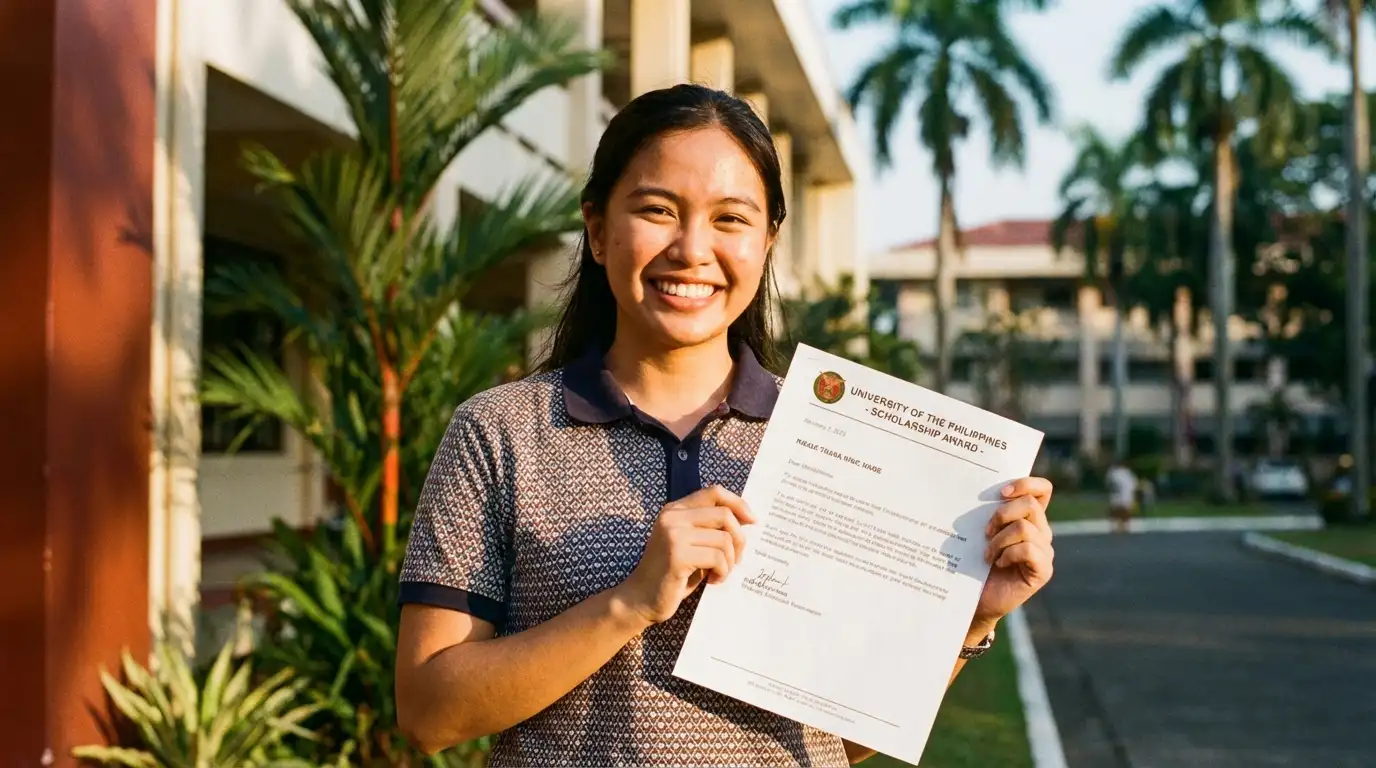
Top Scholarships Available for Filipino Students in 2026: Your Complete Guide to Free Education
Imagine finishing college without your family having to worry about tuition every semester. No more stressful conversations about enrollment fees, no more choosing between school supplies and groceries. For many Filipino families, that kind of relief feels out of reach. But for thousands of students every year, scholarships make it a reality.
Whether you are a graduating senior trying to figure out how to pay for college or a current student looking for ways to reduce the financial burden on your family, this guide covers everything you need to know about scholarships available for Filipino students in 2026.
Why Scholarships Matter for Filipino Students
College in the Philippines is not cheap. Even with the Free Higher Education Act covering tuition in state universities and colleges, there are still miscellaneous fees, living expenses, transportation costs, and school supplies to think about. For students in private universities, the costs are even higher.
Scholarships do more than just cover tuition. Many programs include monthly stipends, book allowances, housing assistance, and even guaranteed job placements after graduation. For a working-class family, a full scholarship does not just change a student’s life. It changes the trajectory of the entire family.
And beyond the financial side, being a scholar carries its own kind of motivation. Knowing that someone believed in you enough to invest in your education has a way of pushing you to show up, study harder, and take your academic performance seriously.

Types of Scholarships Available in the Philippines
Before diving into specific programs, it helps to understand the landscape. Scholarships in the Philippines generally fall into a few categories:
- Government scholarships are funded by national or local government agencies. They tend to have the most structured application processes and the most consistent funding.
- Private and corporate scholarships are offered by companies, foundations, and organizations. They often come with additional benefits like internship opportunities or employment pipelines after graduation.
- School-based scholarships are granted directly by universities and colleges, usually based on academic merit, athletic ability, or financial need.
- International scholarships are funded by foreign governments or international organizations and are typically for outstanding students who want to study abroad.
Within all these types, scholarships are further divided into merit-based (awarded based on academic performance and achievement) and need-based (awarded based on financial situation). Many programs combine both criteria.
Government Scholarships
CHED UniFAST Scholarship (Free Higher Education)
The Commission on Higher Education’s Unified Financial Assistance System for Tertiary Education (UniFAST) is the umbrella program that covers several government scholarship and financial assistance programs, including the Tertiary Education Subsidy (TES) and the Free Higher Education Program.
Under this program, students enrolled in state universities and colleges (SUCs) are entitled to free tuition and other school fees. Students in private higher education institutions may also qualify for the Tertiary Education Subsidy if they meet the income and academic requirements.
To qualify, students generally need to be Filipino citizens, enrolled in an undergraduate program, and able to demonstrate financial need. Applications are processed through your school’s scholarship office, so the first step is to check directly with your registrar or student affairs office at the start of the school year.
DOST-SEI Scholarship
The Department of Science and Technology’s Science Education Institute (DOST-SEI) scholarship is one of the most prestigious government scholarships in the Philippines. It is specifically for students pursuing science, technology, engineering, and mathematics (STEM) courses.
To qualify, applicants typically need a strong academic record with a GWA of at least 85% (or its equivalent) in their previous school year, and must pass the DOST-SEI qualifying examination. The scholarship covers full tuition, a monthly stipend, a book allowance, and a travel allowance for students studying away from home.
The application period usually opens in the second semester of senior high school for incoming college freshmen. Check the official DOST-SEI website for the most current deadlines and exam schedules.
TESDA Scholarship Programs
For students who want to pursue technical and vocational education, the Technical Education and Skills Development Authority (TESDA) offers scholarship programs that cover training costs for various technical-vocational courses.
Programs like Training for Work Scholarship Program (TWSP) and Special Training for Employment Program (STEP) provide vouchers that students can use at accredited TESDA training centers nationwide. Courses range from automotive technology and electrical installation to food and beverage services and healthcare support.
To apply, visit the nearest TESDA provincial or district office and inquire about available programs in your area. Requirements are generally simpler than college scholarship applications, making this an accessible option for students who want to develop a specific skill or trade.
AFP and PNP Scholarship Programs
The Armed Forces of the Philippines (AFP) and the Philippine National Police (PNP) both offer scholarship programs primarily for the children of military and police personnel. These scholarships cover tuition fees and sometimes include additional allowances depending on the specific program and funding availability.
Eligibility is generally limited to dependent children of active or retired AFP and PNP members who are in good standing. If one of your parents serves or has served in the military or police force, it is worth inquiring with the relevant agency’s welfare office about what scholarship programs are currently available.
Local Government Unit (LGU) Scholarships
This is one of the most overlooked scholarship sources in the Philippines, and it should not be. Many barangays, municipalities, and cities offer their own scholarship programs for residents who are currently enrolled in college.
Benefits vary widely depending on the LGU’s budget and policies, but many provide monthly stipends, tuition assistance, or book allowances. The requirements are usually straightforward: proof of residency, good academic standing, and sometimes a short essay or interview.
To find out what is available in your area, visit your barangay hall or city hall and ask the scholarship or social welfare office. Many LGU scholarships are not heavily advertised, so students who proactively inquire are often the ones who benefit from them.
Private and Corporate Scholarships
SM Foundation Scholarship
The SM Foundation Scholarship Program is one of the most well-known and widely applied for corporate scholarships in the Philippines. It covers tuition fees, a monthly stipend, and a school supplies allowance for qualifying students enrolled in priority courses like engineering, education, business, and nursing.
Applicants typically need to have a GWA of at least 80% (or its equivalent) in their previous school year and demonstrate financial need. The application process involves submitting academic records, financial documents, and a personal essay.
SM Foundation announces scholarship openings annually, usually in the first quarter of the year. Watch their official website and social media pages for announcements, and do not wait until the last week to apply.
Ayala Foundation Scholarship
The Ayala Foundation offers scholarship programs that focus on leadership development and academic excellence. Their programs are generally aimed at students enrolled in courses related to business, social sciences, and development-oriented fields.
Beyond financial assistance, Ayala Foundation scholars often have access to mentoring programs, leadership training, and networking opportunities with Ayala Group professionals. Eligibility requirements include strong academic performance and demonstrated leadership in school or community activities.
Visit the Ayala Foundation website for current scholarship offerings, as programs and eligibility criteria are updated regularly.
Jollibee Group Foundation Scholarship
The Jollibee Group Foundation runs scholarship programs primarily targeting students from low-income families who show academic promise. The program covers tuition, school fees, and a monthly allowance, and is open to students enrolled in selected courses at partner schools.
Applicants need to show genuine financial need alongside solid academic records. The foundation places strong emphasis on community involvement and values alignment with their advocacy programs, so a well-written personal statement matters a great deal in this application.
Globe Bridging the Digital Divide Scholarship
Globe Telecom’s Bridging the Digital Divide scholarship focuses on students pursuing information technology, computer science, and related fields. It is designed to support the development of Filipino tech talent and bridge the skills gap in the country’s growing digital economy.
Coverage includes tuition assistance and additional benefits for qualifying scholars. Given that the program is IT-focused, applicants should be enrolled in or planning to take a technology-related course. Check Globe’s official foundation website for current program details and application schedules.
School-Based Scholarships
Most universities in the Philippines have their own in-house scholarship programs that students can apply for directly. These range from full academic merit scholarships (for students with exceptional GWA) to partial tuition discounts for those who maintain a certain academic standing.
Beyond academics, many schools also offer athletic scholarships for varsity players and performing arts scholarships for students with outstanding talent in music, dance, or theater.
Schools like the University of the Philippines offer socialized tuition systems where financial capacity determines how much a student pays. Ateneo de Manila University, De La Salle University, and University of Santo Tomas all have scholarship and financial aid offices that handle both merit-based and need-based applications.
The best way to find out what your school offers is to walk into the scholarship or student affairs office at the beginning of the school year and ask directly. Bring your latest grades and be ready to explain your financial situation if applying for need-based aid.
International Scholarships for Filipino Students
ASEAN Scholarships
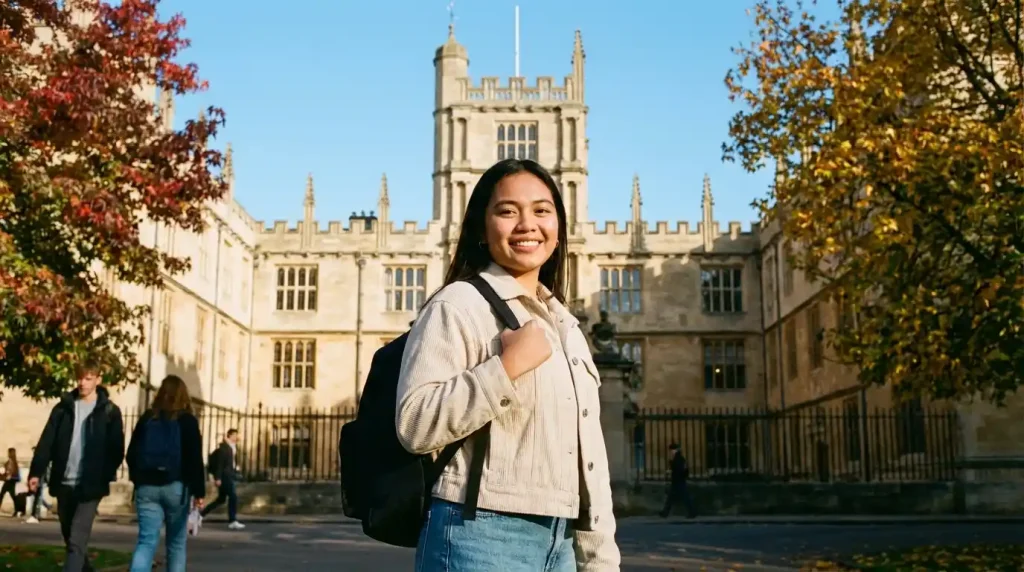
Several ASEAN member countries offer scholarships specifically open to Filipino students, including programs from Singapore, Thailand, and Malaysia. These cover undergraduate and postgraduate studies and typically include tuition, living allowance, and airfare.
Requirements vary by country and program but generally include strong academic records, English proficiency, and age restrictions. The Singapore government’s ASEAN scholarship, for example, is available for senior high school and undergraduate levels and is one of the most competitive in the region.
Chevening Scholarship (UK)
The Chevening Scholarship is a prestigious UK government scholarship for outstanding emerging leaders from around the world, including the Philippines. It covers postgraduate (master’s degree) studies at any UK university and includes full tuition, a monthly stipend, airfare, and other allowances.
To qualify, applicants must have at least two years of work experience, a strong academic background, and demonstrated leadership potential. Applications open annually around August and close in November, so planning well ahead is essential.
Korean Government Scholarship Program (KGSP)
The Korean Government Scholarship Program is extremely popular among Filipino students and for good reason. It covers full tuition, living expenses, airfare, Korean language training, and a monthly allowance for both undergraduate and graduate level studies in South Korea.
One important note: applicants for the undergraduate level must complete a one-year Korean language program before starting their degree. The competition is stiff, but the benefits are among the most comprehensive of any international scholarship available to Filipino students.
What GWA Do You Need for Most Scholarships?
GWA requirements vary depending on the type of scholarship, but here is a general picture:
- Government scholarships (CHED, DOST, LGU) typically require a GWA of 80% to 85% or its equivalent on the 1.0 to 5.0 scale.
- Private and corporate scholarships often set the bar slightly higher, usually at 85% or above.
- International scholarships focus more on overall academic standing and leadership record rather than a specific GWA cutoff.
Before applying, make sure you know your exact GWA. Use this free GWA calculator to instantly compute your General Weighted Average and check if you meet the minimum requirement for your target scholarship. Knowing your number before you apply saves you time and helps you focus on the programs you actually qualify for.
General Requirements for Most Scholarship Applications
While every scholarship has its own specific requirements, most applications in the Philippines ask for the same core documents. Preparing these in advance saves a lot of stress when multiple deadlines hit at once.
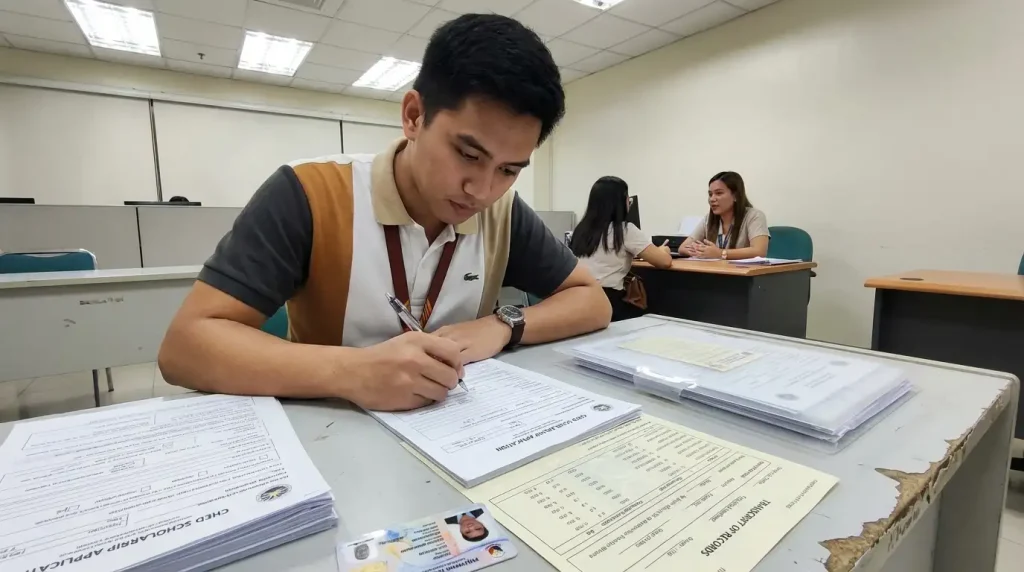
- Certified true copy of grades or transcript of records from your current or previous school
- Certificate of enrollment or registration form for the current semester
- Income documents for need-based scholarships, such as a Certificate of Indigency, ITR, or payslips from parents or guardians
- Recommendation letters from teachers, professors, or school officials
- Personal essay or statement of purpose explaining your goals, financial situation, and why you deserve the scholarship
- Birth certificate (PSA copy) and valid government-issued ID
- 2×2 ID photos, usually required for the application form
Keep both physical and digital copies of everything. Some applications are submitted online, and having scanned copies of your documents ready will save you from scrambling at the last minute.
Tips to Strengthen Your Scholarship Application
Being academically qualified is just the starting point. The students who actually win scholarships are usually the ones who put genuine thought and effort into their applications.
- Start early. The moment a scholarship opens, begin preparing. Waiting until a week before the deadline almost always results in a rushed, weak application.
- Write a compelling personal essay. This is where you stand out from hundreds of other applicants with similar grades. Be honest, specific, and let your real story come through. Scholarship committees read hundreds of generic essays. Yours should feel like it was written by a real person with a real goal.
- Get strong recommendation letters. Ask professors or teachers who know your work well and can speak to your character and potential, not just someone who knows your name. Give them enough time to write something meaningful.
- Maintain your GWA throughout the semester. Most scholarships require you to maintain a minimum GWA to keep your scholarship once awarded. Treat your academic performance as part of the application process, not just a prerequisite.
- Apply to multiple scholarships at the same time. There is no rule against this, and doing so increases your chances significantly. Just make sure each application gets the attention it deserves rather than sending the same essay to every program.
- Stay organized. Create a folder (physical or digital) for each scholarship application. Track deadlines on your calendar and keep all documents labeled and easy to find.

FAQs
Conclusion
A scholarship is not just financial assistance. It is a vote of confidence in your potential. Thousands of Filipino students receive scholarships every year, not because they had perfect grades or came from the right connections, but because they took the time to find the right programs, prepared their applications seriously, and believed they were worth the investment.
You are worth that investment too. Start researching now, prepare your documents, and apply. The best time to look for a scholarship was last semester. The second best time is today.