

How to Compute Your GWA in the Philippines: A Complete Guide
You know that feeling when grades come out, and you start doing mental math in your head? You’re trying to figure out if you’re still on track for honors, or just hoping you didn’t bagsak anything. Whether you’re a high school student trying to understand your report card or a college student worried about Latin honors, understanding your General Weighted Average (GWA) is something every Filipino student needs to know.
This guide will walk you through everything: what GWA is, how it is computed at different levels, and why it matters for your future.
What is GWA?
GWA, or General Weighted Average, is a number that shows how well you are doing academically. It takes all your grades across all your subjects and combines them into one number. For college students, it gives more importance to subjects with more units. For high school students, it works a little differently.
In the Philippines, your GWA matters a lot. It affects whether you qualify for scholarships, whether you make the Dean’s List, and whether you graduate with Latin honors. Schools like UP, Ateneo, De La Salle, UST, and many state universities all use GWA to measure how students are performing.
Your GWA stays with you throughout your academic life. It is worth knowing how it works.
GWA vs GPA: What’s the Difference?
If you have come across the term GPA (Grade Point Average), you might be wondering how it is different from GWA.
GPA is used in the United States. It converts letter grades into a 4.0 scale and averages them, sometimes without considering how many units each subject has. GWA, on the other hand, always considers the number of units per subject at the college level. A 5-unit subject has more effect on your GWA than a 1-unit elective.
Both measure academic performance, but GWA gives a more accurate picture for college students because it accounts for how much work each subject requires.
What Do You Need to Compute Your GWA?
Before you start, prepare the following:
- Your final grade in each subject. Not your midterm grade or your prelim grade. Your final grade.
- The number of units each subject carries (for college students). You can find this on your class card, enrollment form, or school portal.
In the Philippines, academic units (also called credit units) usually refer to how many hours a subject meets per week. A 3-unit subject meets around three hours a week. PE and NSTP usually carry fewer units, while major subjects in courses like engineering or medicine can carry 5 or more.
If you are a high school student, you do not need to worry about units. Your GWA is computed differently, and we will cover that below.
How to Compute GWA for High School Students
For high school students in the Philippines, the GWA is simpler to compute. You just take the average of all your subject grades. There is no unit weighting involved.
Formula:
GWA = Sum of All Subject Grades / Number of Subjects
Here is a sample computation for one semester:
| Subject | Final Grade | Units | Grade × Units |
|---|---|---|---|
| English 2 | 88 | 3 | 264 |
| Mathematics 101 | 82 | 5 | 410 |
| Filipino 2 | 90 | 3 | 270 |
| Physical Education | 92 | 2 | 184 |
| Computer Science 102 | 85 | 4 | 340 |
| TOTAL | — | 17 | 1,468 |
Your GWA for the semester is 86.35.
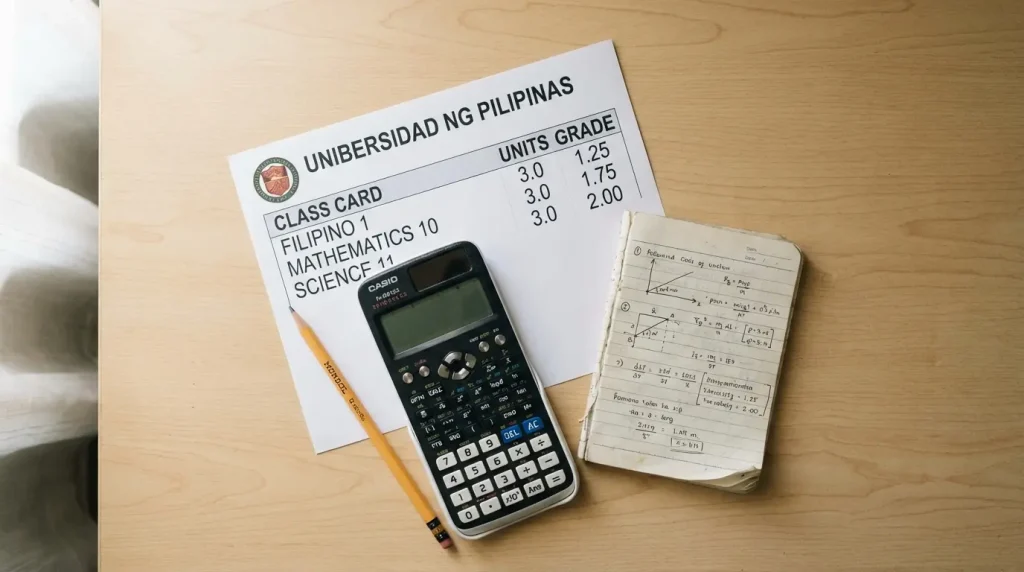
Notice how Mathematics, which has 5 units, pulls your average more than PE at 2 units. That is why it is called a weighted average: subjects with more units count more.
To get your cumulative GWA across all semesters, use the same formula. Just include all your subjects from all semesters combined. Add up all the (Grade x Units) values, then divide by the total number of units you have taken across all semesters.
GWA Computation for Different Grading Systems
This is one of the most important things to understand, because not all Philippine schools use the same grading scale. Make sure you know which system your school uses before computing your GWA.
100-Point Scale
This is the most common system in many Philippine universities and in K-12. Grades go from 65 (or 70) to 100, and a higher number is better. The computation follows the examples shown above. A GWA of 90 on this scale is excellent.
1.0 to 5.0 Scale (UP System and others)
The University of the Philippines and some other schools use a different scale. Here, 1.0 is the highest possible grade, and 5.0 means failed. The passing grade is typically 3.0. The formula is exactly the same, but the direction is flipped: a lower GWA is better on this scale.
For example, a student with a GWA of 1.45 on the UP scale is performing exceptionally well. A GWA of 2.5 is still passing but closer to average. Do not confuse this with the 100-point scale, where higher is always better.
Here is a quick comparison:
| Performance Level | 100-Point Scale | 1.0 to 5.0 Scale |
|---|---|---|
| Excellent | 95 – 100 | 1.00 – 1.25 |
| Very Good | 90 – 94 | 1.26 – 1.50 |
| Good | 85 – 89 | 1.51 – 1.75 |
| Passing | 75 – 79 | 2.50 – 3.00 |
| Failed | Below 75 | 5.00 |
Letter Grade System
Some schools use letter grades like A, B, C, D, and F. These are converted to numbers before computing the GWA. Each school has its own conversion table, so always check your academic handbook to be sure.
What is a Good GWA in the Philippines?

It depends on your goals and which grading system your school uses. Here are some useful benchmarks:
Latin Honors (CHED Guidelines)
The Commission on Higher Education (CHED) sets the minimum GWA for Latin honors. Many schools follow these as a baseline, but some set stricter requirements:
On the 100-point scale:
- Summa Cum Laude – 98 to 100
- Magna Cum Laude – 95 to 97
- Cum Laude – 90 to 94
On the 1.0 to 5.0 scale (e.g. UP):
- Summa Cum Laude – 1.00 to 1.20
- Magna Cum Laude – 1.21 to 1.45
- Cum Laude – 1.46 to 1.75
Remember: on the 1.0 to 5.0 scale, a lower number is better. Always check with your school’s registrar for the exact cutoffs they follow.
Dean’s List
Most schools require a GWA of at least 85 to 88 on the 100-point scale (or around 1.50 to 1.75 on the 1.0 to 5.0 scale), with no failing or incomplete grades, to qualify for the Dean’s List each semester.
Scholarships
Government scholarships like CHED scholarships and DOST-SEI usually require a GWA of 83 to 90 or higher on the 100-point scale. Some private scholarships are more strict and require a GWA of 90 and above.
Common Mistakes When Computing GWA
Even students who know the formula can still get it wrong. Watch out for these:
- Using your midterm or prelim grade instead of your final grade. Your GWA is based on the final grade that appears on your official transcript. Midterm grades are just checkpoints, not your final record.
- Leaving out some subjects. Every subject you enroll in counts, including NSTP, PE, and electives. Skipping a subject with a low grade will make your computed GWA look better than it actually is.
- Ignoring failed subjects. A failed grade still gets multiplied by its units (for college) or included in the average (for high school). It counts whether you like it or not.
- Mixing up the grading scale. If your school uses the 1.0 to 5.0 scale, do not panic when your GWA looks like a low number. A 1.75 is a great GWA on that scale. Always know which system your school uses.
- Mixing up semestral and cumulative GWA. Your semestral GWA covers only one semester. Your cumulative GWA covers all your semesters combined. Make sure you know which one a scholarship or award is asking for.
Tips to Improve Your GWA
There are no shortcuts, but there are smart habits that can help.
- Focus on subjects with more units (for college students). A 5-unit major subject affects your GWA much more than a 1-unit elective. Spend more time on subjects that carry more weight.
- Do not give up after one bad grade. A failing mark is painful, but it is not the end. Focus on doing better in your other subjects.
- Ask for help before it is too late. If you are struggling, talk to your professor or find a study partner early in the semester. Do not wait until finals week.
- Stay consistent every semester. It is harder to fix a low GWA at the end than to maintain a good one from the start. Small, consistent efforts go a long way.
- Track your grades as they come in. Do not wait for your official transcript to find out where you stand. Keep a simple list of your grades and units, so you always know your running average.
Use a GWA Calculator for Faster Results
Computing manually works, but it takes time. If you enter the wrong number somewhere, your whole result will be off. If you want a faster and more reliable way, you can use a free GWA calculator made specifically for Filipino students.
Just enter your grades and units, and it gives you your GWA right away. It supports both the 100-point system and the 4-point system, and you can use it for single semesters or multiple semesters. It is a helpful tool to save, especially during enrollment season or when you are preparing for graduation.
FAQs
Conclusion
Your GWA is not just a number. It reflects the work you put in every semester, the subjects you pushed through, and the effort you showed up with every day. Now that you know how it is computed for both high school and college, and now that you understand the difference between grading scales, you can take full control of it.
Track it, plan around it, and work toward the goals you have set for yourself. Whether you are aiming for Latin honors, trying to qualify for a scholarship, or simply want to know where you stand, you now have everything you need. Use that knowledge well.